Inside Young Female Playwright: Theater Culture, Misogyny, and the Complexities of Women’s Authorship
Updated: May 24
Young Female Playwright opened the door to a far larger conversation than filmmaking. What emerged was an honest exploration of the emotional, psychological, and cultural pressures women encounter within creative environments.
Director Pony Nicole Herauf and writer/actor Ellie Moon spoke candidly about theater culture, vulnerability, collaboration, misogyny, and the difficult balance between artistic expression and public perception. At the heart of our FiB Live was the film’s examination of legitimacy: who is permitted to tell difficult stories, whose voices are trusted, and why women artists are so often expected to defend the emotional truths within their work.

Pony Nicole Herauf touched upon society’s fascination with the “prodigy” narrative and the obsession with exceptionally young artists being framed as geniuses before they’ve had time to fully develop their craft. While audiences celebrate youthful talent, Pony pointed out the contradiction that often follows is that young women are praised for their youth while simultaneously being harshly judged and held accountable in ways that undermine their experience and authority.
“People are obviously kind of obsessed with the idea of a prodigy or a wonder kid… But it’s hard because then it kind of takes away the idea of, okay, well, it takes people a long time to learn.” Pony Nicole Herauf

Ellie Moon reflected on how narrow that window of acceptance can feel for women artists, explaining that there is often only a brief period between being viewed as “too young” to be taken seriously and suddenly being considered “too old.” She noted that women are frequently infantilized in ways men are not, observing that a 26-year-old male artist would likely not face the same level of scrutiny surrounding age and credibility.
“There’s definitely such a short window where you're not so young that you're gonna be infantilized as a woman… and then, okay, now she’s too old.” Ellie Moon

The filmmakers elaborated about the film’s exploration of abuse, consent, memory, and the emotional ambiguity surrounding personal experience.
Young Female Playwright intentionally navigates the uncomfortable gray areas that often shape real human experiences.
Experiences with assault and abuse are much more confusing, and it takes time to understand them. Ellie Moon
Pony Nicole Herauf described the subject matter as a “balancing act,” emphasizing that experiences involving assault, abuse, or boundary violations are deeply personal and impossible to reduce into a singular narrative. She reflected on how society often pressures women to “prove” whether what happened to them was “bad enough” in order to justify speaking about it publicly.
“You can't define things with singularity when they're such individual experiences.” Pony Nicole Herauf

When asked what advice they would give filmmakers preparing to make their first feature, Ellie Moon emphasized the importance of writing within the reality of the resources available to you. She explained that Young Female Playwright was intentionally crafted around actors, locations, and collaborators the team already knew and trusted.
“I really wrote for the resources I had, if you want that freedom, have those limitations in mind from the beginning. Ellie Moon
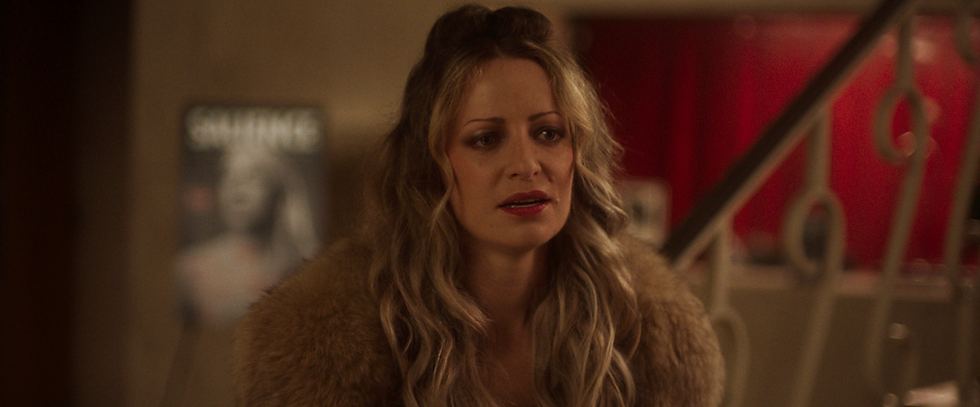
One of the film’s standout characters is Rocks, played by Karen Knox, a role Ellie Moon wrote specifically for her. As Ellie explains, “Rocks was always written for Knox,” allowing the character to naturally embody Karen Knox’s unmistakable energy and presence.
What makes Rocks so compelling is the contradiction at the center of her character. On the surface, she appears chaotic, outrageous, and emotionally untethered. She's someone who seems to move through life without rules. Yet underneath that looseness lies a deeply rooted moral center. Ellie describes being drawn to that duality: a character who initially feels carefree and uninhibited, but who ultimately holds strong convictions about right and wrong, particularly regarding what she believes Millie may have done.
Director Pony Nicole Herauf describes Knox’s unforgettable screen presence as someone who walks into a room with “Nicorette gum and this giant blonde hair” and instantly commands attention.

Jaek Eastcott, plays Devon, bringing a very specific type of energy to Young Female Playwright , the overly confident bookstore intellectual whose sincerity somehow makes every interaction even more hilarious. Whether he’s casually discussing “deeply personal” writing or speaking with complete conviction about himself, Devon becomes the kind of character that feels instantly recognizable. What makes the performance work so well is how understated it is. The humor rarely comes from Devon trying to be funny; it comes from how seriously he takes himself. During the FiB Live conversation, Pony Nicole Herauf laughed about how familiar the character felt, describing her early twenties as “sitting in bars with men saying the craziest things to me so seriously. LOL!"
"Young Female Playwright" FiB Live Here:
Listen To The FiB Live Interview Here:


Pony Nicole Herauf is a queer filmmaker and performer based in Toronto.
Her films have played at festivals such as TIFF Next Wave, VIFF, Inside Out, Fantasia, Whistler, Dances With Films: New York, Calgary Underground, Mammoth Lakes, Swiss Youth, Chilliwack Independent, and the Palm Springs International. They have also streamed on CBC Gem.
Young Female Playwright is her feature length directorial debut. Pony was awarded the New Visions Award for the film at the Cinequest Film Festival. Pony teaches in the Acting Department at Toronto Metropolitan University and is a frequent collaborator of the avant-garde theatre/dance troupe ROCK BOTTOM MOVEMENT. She lives with her perfect fiancé and her puppy Lamby.
Pony is a scorpio and lover of fizzy lemonade.
View Pony's website here.

Ellie Moon is an actor and writer. Her debut feature, Adult Adoption —directed by Knox, written by and starring Ellie — premiered to critical acclaim, was named a Globe and Mail Best Film of 2023, and is now streaming on Amazon Prime. Ellie’s works as playwright premiered at Crow’s Theatre, Tarragon Theatre, and Nightwood Theatre, and are published by Talonbooks. Her plays have been described as “remarkable,” “incredible,” “some serious art,” and “[a] real marvel” (The Globe and Mail).
Ellie Moon will appear in the upcoming film Everybody Wants to F*ck Me, produced by LuckyChap (Barbie), and has worked as an actor across theatre (Soulpepper, Crow's), film (Cannes, TIFF, Fantasia), television (CBC, Netflix, Peacock), and audiobooks (Penguin Random House). Her debut novel is represented by Cody Caetano at CookeMcDermid.
View their website here.


My first interaction with Young Female Playwright was with the film’s poster. I was immediately moved by it, and I remember thinking that I had to find out what this film was about and who created it. This is how it all started...
The poster for Young Female Playwright became an extension of the film’s emotional and thematic identity. During the FiB Live conversation, Pony revealed that she always envisioned the artwork as a painted piece rather than a traditional digitally assembled poster. Created by Calgary-based artist, Gabby Coates, the final image intentionally evokes the feeling of classic 1970s film posters where the artwork feels handcrafted, personal, and emotionally textured.
One of the poster’s most striking visual choices became the red lipstick smear across Millie’s mouth. Pony described the image as carrying a “Scarlet Letter” sensibility, a feeling that the character has been marked. At the same time, she was interested in the idea that the painting itself almost looked vandalized, as though someone had altered or damaged something originally beautiful. That visual concept directly mirrors many of the film’s central themes surrounding accusation, perception, shame, and public judgment.
— Julissa Scopino, on behalf of Filmmakers in Boardrooms


